


"Freedom is always the freedom of the one who thinks differently" - Rosa Luxemburg
One afternoon last June, Salwan Momika, an Iraqi, Christian refugee living in Sweden, stepped in front of the largest Mosque in Sweden and lit several pages from the Quran on fire. Momika had received a permit from the Swedish authorities and police were there monitoring the event.
Momika’s Quran burning caused an international uproar and widespread condemnation among world leaders; even the Pope and Putin felt the need to weigh in.
See this panel on Religion and Free Speech as part of Plebity’s ongoing conversation on Free Speech and the Left
The event has been both downplayed as a trivial provocation and highlighted as a dangerous act of hateful bigotry. It has been called a manipulation by the far right and also a failure by Sweden, said to have favored intolerance in misguided support of free speech.
All of these characterizations miss the point. The right to criticize religion, in whatever way one chooses, is one of the most important and hard-fought rights in the history of the West. From the time of the French revolution it was a battle historically led by the left.
There is an odd exceptionalism in the West, and particularly among today’s woke left, that is unable to see that the evils of racism, intolerance or religious oppression can have any other source besides Western white supremacy.
Nonetheless, outside the West, Islam is hardly a marginalized belief, and it is non-Muslim minorities who tend to be the targets of blasphemy laws.
Is criticizing a major religion an expression of intolerance against a marginalized minority?
These blasphemy laws are still very much with us today. As recently as 2019, according to a Pew Research survey, 40% of the countries of the world, or 79 countries, still had blasphemy laws on the books. Seven countries still have death penalties for blasphemy—Afghanistan, Brunei, Iran, Mauritania, Nigeria, Pakistan and Saudi Arabia.
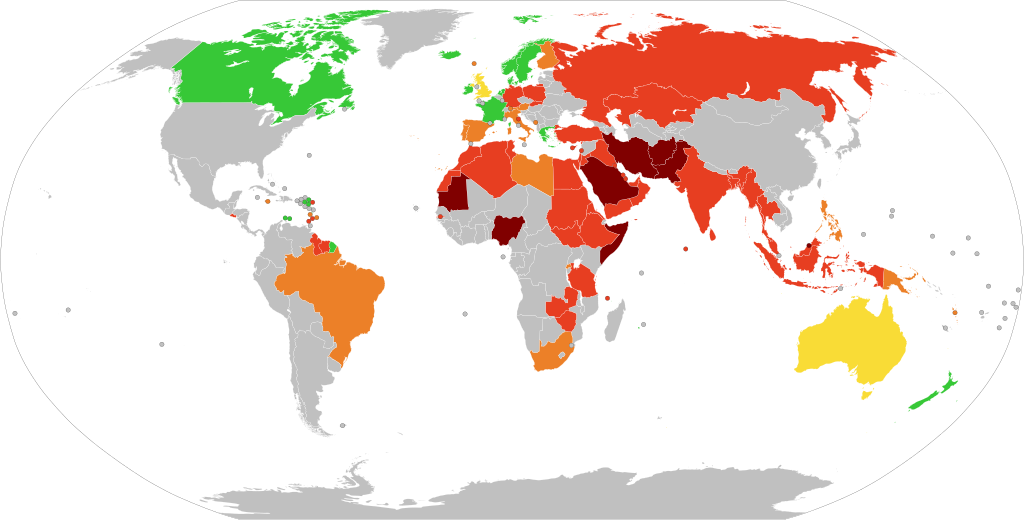

Conquistador, Blasphemy laws worldwide, CC BY-SA 4.0

Do blasphemy or hate speech laws protect minorities?
Some countries in the West, such as Germany and France, have adopted hate speech laws—essentially updated forms of blasphemy laws where the state decides what is acceptable speech. There is a widespread feeling, particularly among today’s left, that hate speech laws target intolerance and are therefore a good thing.
This view is based on a mistaken understanding of how hate speech or blasphemy laws work in reality. Where blasphemy laws exist they are found to be used mostly against minorities and not to protect them.
The Pew Research Center, for instance, finds a correlation between the existence of blasphemy laws and governmental discrimination of minorities. In 55% of the countries with blasphemy legislation, the state engages in discrimination of minorities, while this is only the case in 22% of the countries without blasphemy legislation. -
The Organization of Islamic Cooperation (OIC), which calls itself ‘the collective voice of the Muslim world’, lists some 50 member states, including such bastions of human rights and democratic freedoms as Saudi Arabia, Afghanistan and Iran.
The OIC thinks we should all adopt blasphemy laws and has been lobbying relentlessly to make these laws a worldwide standard. It has seized on the Quran burning in Sweden to repeat its call for universal punishment of blasphemy, stating that “[t]he relevant stakeholders must ensure that the perpetrators of such acts are brought to justice and appropriate measures are taken to prevent similar incidents in the future.”
Hate speech laws and blasphemy laws may be born out of good intentions, but they are an irresistible tool for those in power to suppress speech they don’t like.
The right to challenge religious power, ‘the opium of the masses,’ was a hard and long fought battle that was opposed at every step of the way with arrests, torture and the spiritual blackmail of excommunication and eternal damnation.
Criticism of the dominant religion would have until very recently been a standard position among the left; part of a long, painful struggle by the weakest and most marginalized against religious oppression—in particular against the Catholic Church, which for centuries was the power center throughout Europe. It is easy to forget how religion used to rule over every aspect of our lives in the West.
In 1765, Francois Jean Lefebvre, known as le Chevalier de la Barre, was the last person condemned and executed (by the state) for blasphemy in France. His crime was the failure to doff his cap to show respect for a passing religious procession. He was tortured, beheaded and his body burned.
In spite of all the lessons from history there is pressure today to turn back the clock and institute new laws to protect religion from criticism.
Passing new hate speech laws or enforcing existing ones to ban certain acts or words that are deemed blasphemous or hurtful is simply replacing the yoke of religious intolerance we worked so long and hard to remove.
Leftist martyr Rosa Luxemburg would be one of the first in line to be prosecuted under the rubric of blasphemy laws for her sharp criticism of the Christian church. In her essay Socialism and The Churches she deplored how Church institutions both supported and profited from brutal exploitation of the very weakest.
“...the clergy falsifying the early teaching of Christianity, which had as its object the earthly happiness of the lowly, tries today to persuade the toilers that the suffering and the degradation which they endure come not from a defective social structure, but from heaven, from the will of “Providence”. Thus the Church kills in the workers the strength, the hope, and the will for a better future, kills their faith in themselves and their self-respect. The priests of today, with their false and poisonous teachings, continually maintain the ignorance and degradation of the people.” -Rosa Luxemburg
Speech can be hurtful, but the right to free speech is still an essential tool for throwing off oppression.
If people on the left who care about social justice goals and material well-being are to be consistent, they have to stand firm in support of free speech that challenges power—all sources of power. That includes the right to criticize religion—all religions.
It seems to be a hard-wired human trait that along with fervent beliefs, whether ideological or religious, comes a powerful need to force others to adopt those same beliefs. But there is an equally powerful human need to arrive freely at one's own opinions and to feel free to honestly express them. It’s only through difficult conversations, where all sides can be openly explored in good faith, that we can build up our personal tolerance for hearing uncomfortable ideas and make up our own minds. Legislating hate speech or blasphemy laws takes us in the exact opposite direction.
Suppression of speech, even when it's done in the name of serving laudable social justice goals, is the opposite of promoting genuine tolerance and real justice.
-Mark White